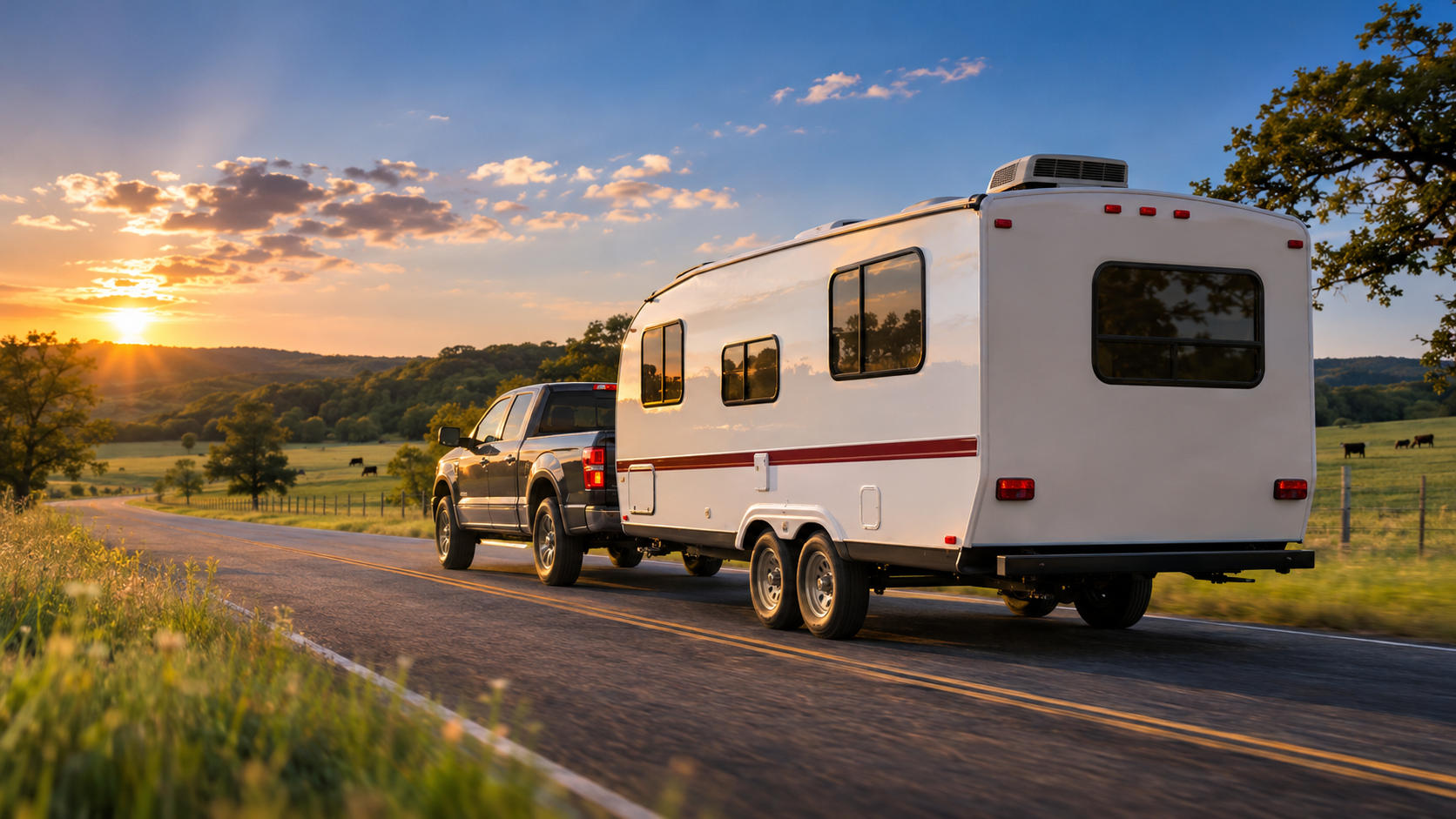
Do you need a special license to drive or tow an RV in Oklahoma?
In Oklahoma, most RV owners do not need a special license. A regular Class D driver's license covers an RV used for personal or family travel, and the state sets no weight limit for that use. You need a commercial license only if you use the rig for business. Some other states, including Texas, require a non-commercial Class A or B license for heavier rigs.
What license do you need to drive an RV in Oklahoma?
You need a standard Class D license, the same one you use to drive a car. Oklahoma Title 47 treats a recreational vehicle as a Class D vehicle when it is equipped as temporary living quarters for recreation, camping or travel and is used solely as a family or personal conveyance.
Service Oklahoma describes Class D as covering every vehicle or combination of vehicles except commercial Class A, B and C. Its fee schedule puts it more simply: Class D covers all other vehicles regardless of weight.
In practice, a Class D license covers a motorhome, a travel trailer behind your pickup, a fifth wheel, a toy hauler or a truck camper, as long as the trips are your own. Oklahoma does not add a separate test for the RV itself.
If you plan to use the RV for family trips, your license is not the limiting factor in Oklahoma. The ratings on your tow vehicle are, so shop for an RV that fits the truck or SUV you already drive.
When does an RV driver need a CDL?
A commercial driver's license applies to a single vehicle rated at 26,001 pounds or more, or to a combination rated at 26,001 pounds or more with a towed unit rated over 10,000 pounds. Personal-use RVs are exempt in Oklahoma.
Oklahoma's Department of Public Safety lists those weight triggers for a CDL. It also lists vehicles designed to carry 16 or more passengers and any vehicle that must display hazardous materials placards. Federal regulators have said since 1993 that CDL rules do not apply to RVs used strictly for non-business purposes, and Oklahoma's recreational exception follows the same idea. The RV has to be a family or personal conveyance.
That changes if you carry people or cargo for pay, or use the RV as part of a business. Talk to Service Oklahoma before you drive in that situation. The same applies to converted coaches built from buses. The base vehicle was designed to carry 16 or more passengers, so confirm how Oklahoma classifies it before you buy.
Federal guidance also lets states extend CDL requirements to RVs, so the state where you live matters.
Which states require a special license to drive or tow a heavy RV?
A handful of states require a non-commercial Class A or B license once an RV or tow combination passes certain weight or length limits. Texas, California, Kansas, Nevada and Maryland are among them.
A non-commercial license is not a CDL. It is a heavier class of regular license, and the state usually requires a knowledge test, a skills test or both. The Texas Department of Public Safety says operators of RVs driven for personal use are exempt from a CDL but may still need a Class A or B license, depending on the vehicle's weight.
Here is how those five states set their limits:
Texas requires a Class B license for a single vehicle rated 26,001 pounds or more, and a Class A license for a combination rated 26,001 pounds or more with a towed unit rated over 10,000 pounds.
California applies its rules to a single vehicle over 26,000 pounds or a motorhome over 40 feet, and to towing a travel trailer rated over 10,000 pounds or a fifth wheel rated over 15,000 pounds.
Kansas applies its rules to any vehicle or combination rated over 26,000 pounds.
Nevada applies its rules to a motorhome rated over 26,000 pounds, or a combination over 26,000 pounds towing any vehicle, and adds a J endorsement to tow a vehicle rated over 10,000 pounds.
Maryland applies its rules to any vehicle or combination rated over 26,000 pounds.
The Texas details come from the Texas DPS. The others come from a state summary published by the RV Industry Association in 2017, and states change their rules, so confirm the current requirement with your state's driver license agency before you buy a heavy rig.
Texas and Kansas both border Oklahoma. If you live in a state with its own rule, or you drive in from out of state to buy, check your home state's requirement before you choose a large rig.
How do you check whether your RV and tow vehicle reach those limits?
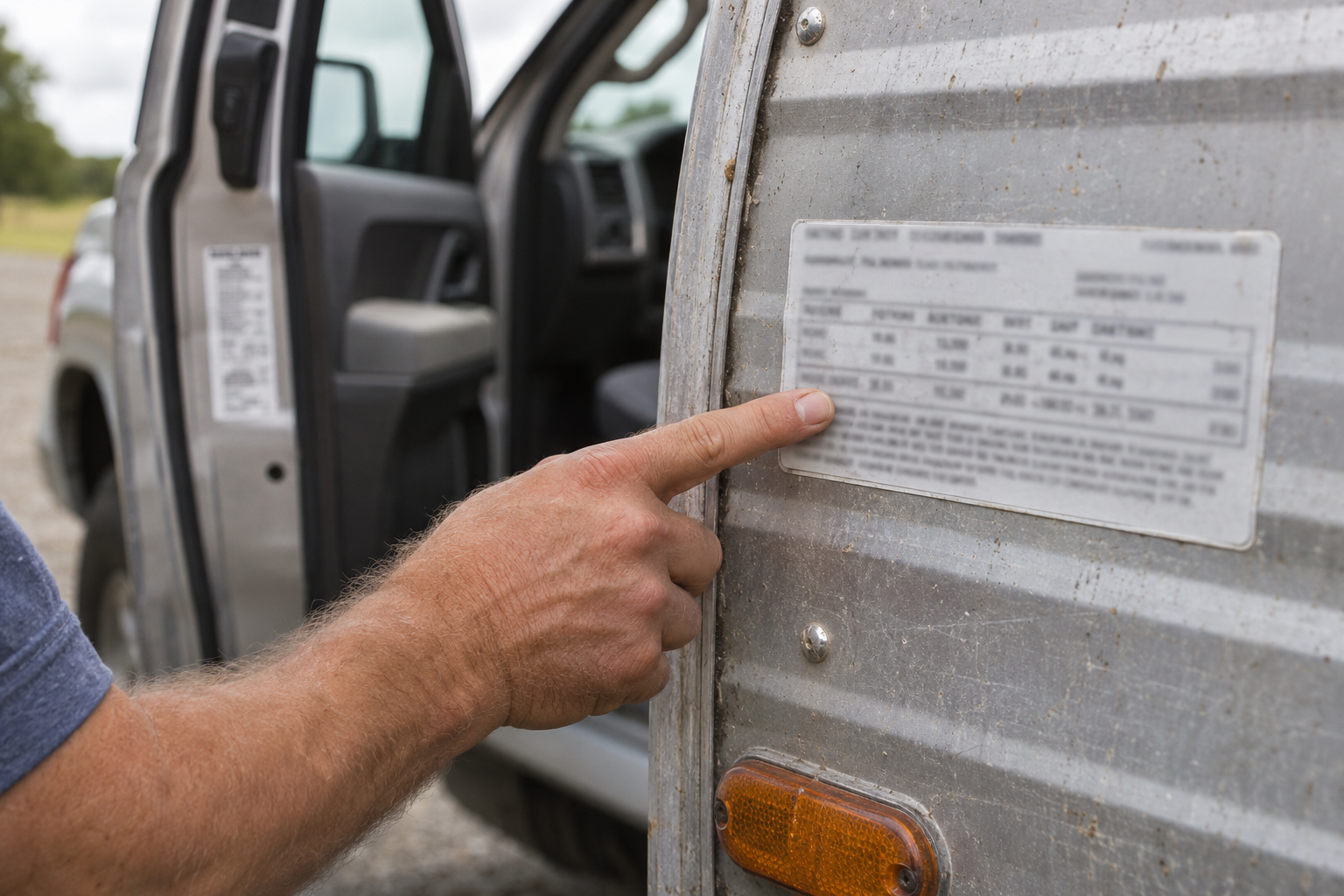
Add the gross vehicle weight rating (GVWR) of your tow vehicle to the GVWR of the trailer. Then compare the total, and the trailer's rating on its own, to your state's thresholds.
Find the RV's GVWR on the federal certification label attached to the unit.
Find the tow vehicle's GVWR on the label inside the driver's door jamb.
Add the two ratings. A combined rating of 26,001 pounds or more is the first trigger.
Look at the trailer's rating alone. A rating over 10,000 pounds is the second trigger, and both Oklahoma's CDL rules and Texas' Class A rule use it.
Compare your numbers to the rules in the state where you live.
Licensing thresholds are written around GVWR, not the dry weight printed in a brochure. Dry weight is the empty weight, and GVWR is the maximum loaded weight the manufacturer rates the RV to carry, so the rating is always at least as high. Some larger fifth wheels list dry weights above 10,000 pounds, which puts their ratings over that line before you load a single bag.
A truck camper works differently. It rides in the bed of your pickup, so the truck's own GVWR decides the license, and the camper counts against the truck's payload.
CampInc's Tow Guide lets you look up your vehicle's towing capacity and see which RVs fit. The guide is for reference only, so confirm the numbers in your owner's manual.
Which RV type is simplest from a licensing standpoint?
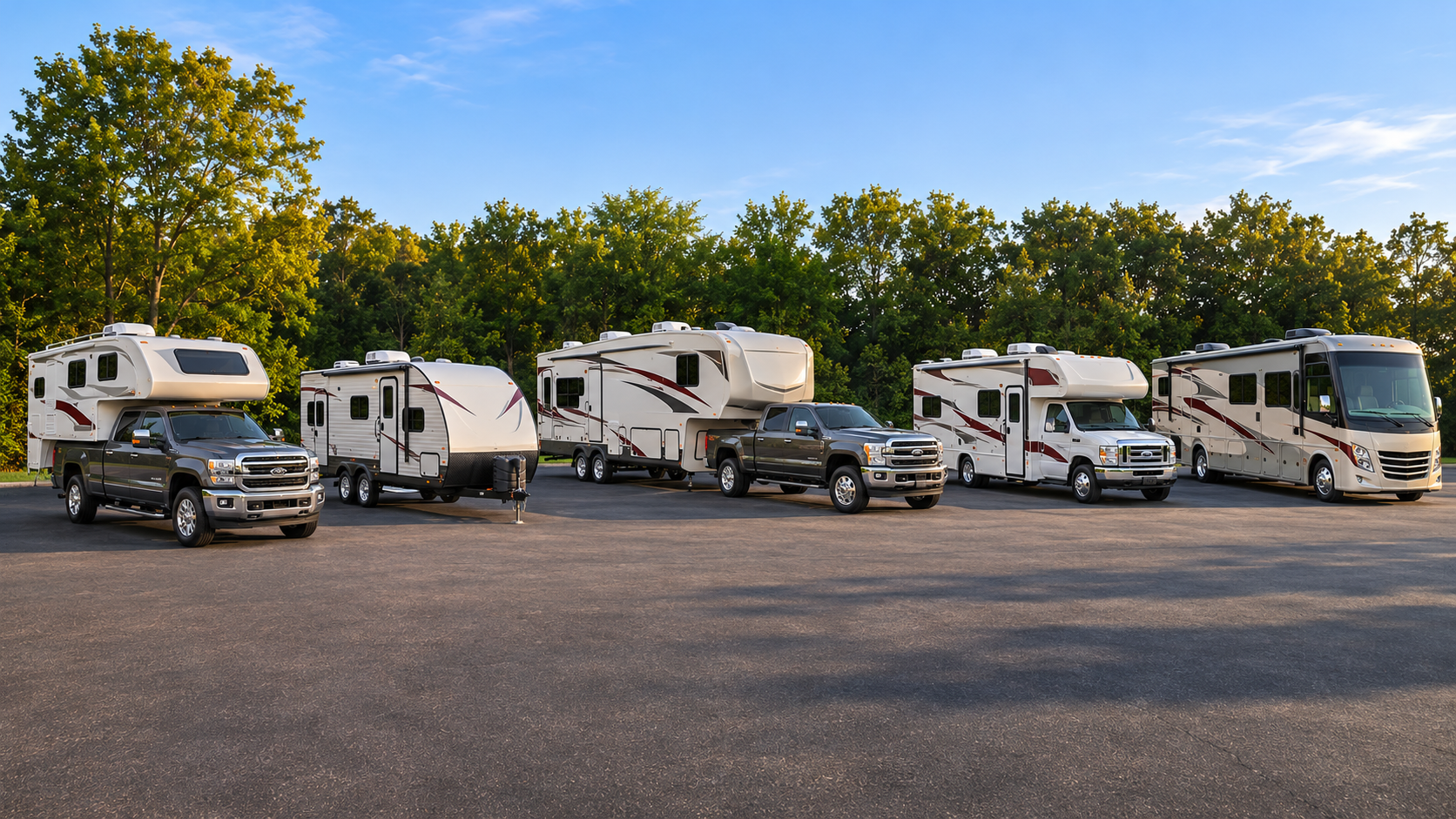
Truck campers and lighter travel trailers are the least likely to reach any state's limits. Larger fifth wheels, toy haulers and big motorhomes are where state rules start to matter.
A truck camper is governed by the pickup's own GVWR. The loaded camper counts against payload, so check that rating too.
A travel trailer is governed by the tow vehicle's GVWR plus the trailer's GVWR. Compare the combined rating if the trailer is rated near 10,000 pounds.
A fifth wheel or toy hauler is governed by the truck's GVWR plus the trailer's GVWR. Larger models can top 10,000 pounds on their own.
A Class C motorhome is governed by the motorhome's own GVWR. Towing a car adds a second rating to check.
A Class A motorhome is also governed by its own GVWR, and the largest coaches can be rated above 26,000 pounds.
For a first purchase with the fewest licensing questions, match the RV to the truck you already own and then check the numbers. If you are still deciding between styles, our post on why to buy a travel trailer covers the tradeoffs, and the fifth wheel guide explains what you gain by stepping up to a heavier unit.
What else should you check before you drive or tow an RV?
Beyond your license, check your tow vehicle's towing capacity, its payload, the hitch class and the brake setup. A license lets you drive the rig. These numbers decide whether the rig is safe to drive.
Towing capacity is the most quoted figure, and payload is the one buyers overlook. Tongue weight or pin weight, passengers, gear and a hitch all come out of the truck's payload. A trailer brake controller lets you control the trailer's brakes from the cab, and extended mirrors help you see past the trailer's width. Insurance and registration are separate steps, so ask your insurer how they classify the RV before the first trip.
Practice before you leave. An empty parking lot is a good place to rehearse backing up, turning wide and judging stopping distance. Our RV packing tips for beginners can help you load the rig evenly once you are comfortable driving it.
What licensing mistakes do new RV buyers make?
Most mistakes come from assuming one number or one state's rule applies everywhere.
Using dry weight instead of GVWR. Licensing thresholds use ratings, and a loaded RV weighs more than its brochure number.
Assuming other states match Oklahoma. Texas and Kansas, for example, have non-commercial classes that Oklahoma does not apply to personal-use RVs.
Buying a heavy combination before adding the ratings. Check the trailer's GVWR and the truck's GVWR together first.
Mixing up a CDL with a non-commercial Class A or B license. They are separate credentials with different rules.
Skipping the question on converted coaches. A coach built from a bus can raise extra classification questions.
Treating a first tow like a normal drive. Brake lag, trailer sway and wide turns catch new owners off guard.
How can CampInc help you pick an RV that fits your license and tow vehicle?
CampInc is an RV dealership at 1217 South George Nigh Expressway in McAlester, Oklahoma. The lot carries new and used travel trailers, fifth wheels, truck campers, toy haulers, Class C motorhomes and Class A motorhomes from brands that include Forest River, Gulf Stream and Sunset Park RV Manufacturing.
Start with your tow vehicle. Run it through the Tow Guide, write down the GVWR from the door jamb label, and then ask the sales team to point out the certification label on any RV you like. A trailer rated well under your truck's capacity is easier on the driver and easier on the license.
When you are ready to price a purchase, CampInc has pages for financing and for trading in your current RV. Questions about a unit you already own go through the service and parts page. You can also contact the team directly or see the McAlester location page for the address.
Frequently asked questions
Do I need a CDL to drive a Class A motorhome in Oklahoma?
No, not for personal or family use. Oklahoma treats an RV used solely as a family or personal conveyance as a Class D vehicle, so a regular driver's license covers it. A CDL comes into play if you use the motorhome for business or to carry people or cargo for pay.
Do I need a special license to tow a travel trailer in Oklahoma?
No. A Class D license covers a combination of vehicles when the trailer is used for personal camping. Oklahoma's CDL rules start with a towed unit rated over 10,000 pounds and a combined rating of 26,001 pounds or more, and personal-use RVs are exempt from them.
Do I need a special license to tow a fifth wheel or toy hauler?
In Oklahoma, a Class D license is enough for personal use, even with a heavy fifth wheel or toy hauler. Other states differ. Texas, for example, requires a Class A license when a combination is rated 26,001 pounds or more and the towed unit is rated over 10,000 pounds. Check the rules where you live.
What is the difference between a CDL and a non-commercial Class A or B license?
A CDL is for commercial driving and comes with federal testing and medical rules. A non-commercial Class A or B license is a heavier class of regular license that some states require for large RVs used for personal travel. It usually involves a skills test, but it does not make you a commercial driver.
Does the license rule use my RV's dry weight or its GVWR?
Licensing thresholds are written around gross vehicle weight ratings (GVWR), not the dry weight in a brochure. Dry weight is the empty weight, while GVWR is the maximum loaded weight the manufacturer rates the RV to carry. You can find the GVWR on the RV's certification label.
Do I need a special license to drive an RV in Texas?
Possibly. The Texas DPS says RV operators driving for personal use are exempt from a CDL but may need a non-commercial Class A or B license based on weight. A single vehicle rated 26,001 pounds or more calls for Class B. A combination rated 26,001 pounds or more with a towed unit over 10,000 pounds calls for Class A.
Do I need a special license to drive a truck camper?
A truck camper rides in the bed of your pickup, so the license depends on the truck's GVWR. Pickups sold for personal use carry ratings well below 26,001 pounds, and a standard Class D license covers a truck camper in Oklahoma. Check the truck's payload rating too, because the loaded camper counts against it.
Final takeaway
An Oklahoma Class D license covers personal-use RVs of any size, but the weight ratings on your tow vehicle and trailer still matter, and other states may set their own rules. Browse new RVs or used RVs at CampInc, look up your truck in the Tow Guide, or call (918) 426-8008 and talk with the team in McAlester.
The internal linking suggestions, SEO and AEO metadata, and image prompts from my last message are unchanged. The only edits were replacing the state table and the RV type table with bulleted lists.